 Atlanta Pallet Rack
New Teardrop Pallet Racks
Outfit your warehouse with the most widely used pallet rack style in the US — manufactured in-house at our Conyers, GA facility, so you get factory-direct pricing and fast turnaround instead of waiting on a third-party reseller.


Why Teardrop?
- Most common style in the US — widely available parts and easy to cross-reference.
- Pin-and-slot connection — no bolts required for standard assembly.
- Recognizable by sight — the upright slots resemble an inverted teardrop shape.
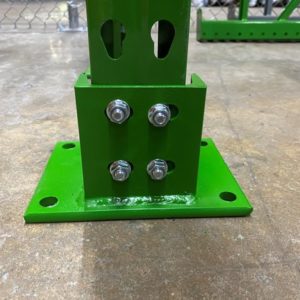
- Compatible hardware — safety clips and base plates are stocked and shipped same-week.
Hardware & connectors



Common questions
How do I know if my existing rack is Teardrop style?
What load capacity should I plan for?
Can I mix new Teardrop components with my existing used rack?
Teardrop Pallet Rack Buying Guide
What Are Teardrop Pallet Racks?
Teardrop pallet rack — sometimes called Interlake Old-Style — is the most widely installed selective racking format in the US. The upright frame has a column of teardrop-shaped punch-outs running its length, and the beam end connector hooks directly into these slots. No bolts, welding, or special tools are needed for a standard installation: beams simply drop into place and lock with a safety clip.
Because the format is so widely manufactured, replacement parts and compatible accessories are easy to source even years after the original installation, which is part of why it remains the default choice for general warehouse storage.
Applications
Teardrop racking is a general-purpose format, which makes it suitable across a wide range of warehouse environments:
Distribution Centers
High-turnover pallet storage with frequent picking and restocking.
Manufacturing Facilities
Raw material and finished goods storage adjacent to production lines.
Retail & E-Commerce
Mixed-SKU storage supporting order fulfillment.
Cold Storage
With appropriate finish and hardware selection for temperature-cycling environments.
3PL Facilities
Flexible, easy-to-reconfigure storage for varying client inventory.
Bolted Bracing vs. Welded Bracing
Teardrop uprights are braced one of two ways, and the choice affects both cost and how the frame behaves over its service life:
Welded Bracing
Fuses the diagonal and horizontal braces directly to the columns at the factory. Produces a rigid, one-piece frame that doesn’t loosen over time, but the finished frame is bulkier to ship and can’t be broken down for shipment or reconfigured on-site.
Bolted Bracing
Connects braces to the columns with bolts instead of welds. Frames ship flat and are assembled on-site, lowering freight cost and making it straightforward to swap a damaged brace. Bolted connections should be checked periodically and re-torqued if they work loose from forklift vibration.
Neither option is universally “better” — welded bracing suits permanent, high-traffic installations where minimal maintenance is the priority, while bolted bracing suits facilities that value lower freight cost, easier on-site assembly, or the ability to reconfigure a layout later.
Installation Tips
- 1Confirm the building’s actual clear height and column spacing on-site before finalizing a layout — a tape measure beats an assumption every time.
- 2Anchor every upright frame to the slab per the manufacturer’s base plate specification; an unanchored frame is a common cause of tip-over incidents.
- 3Verify beam safety clips are seated on every beam connection before loading — this is the single most-skipped step during a rushed installation.
- 4Leave manufacturer-specified clearance between back-to-back rows and at aisle ends for forklift maneuvering.
Safety Considerations
- Never exceed the load rating posted on the rack’s capacity placard, even temporarily.
- Inspect uprights and beams regularly for bent columns, cracked welds, or missing safety clips — damage to a single frame can affect the load rating of an entire bay.
- Install rack guards or column protectors at aisle ends and other high-traffic points where forklift contact is most likely.
- Keep beam-level load limits visible to warehouse staff, since mixed pallet weights on a single level are a common way capacity gets exceeded unintentionally.
Need help specifying the right teardrop components?
Send us your rack dimensions and load requirements — we’ll confirm exact part numbers before you order.